Get Wheel Delivery from just £30

  • Choose Vehicle
  • Favourites
  • Basket

Get Wheel Delivery from just £30

  • Choose Vehicle
  • Favourites
  • Basket
Blogs Blogs

What technology developed in F1 Racing has made it into commercial vehicles?

  Image Credit: By NRMA Motoring and Services from Sydney, Australia via Wikimedia Commons Aside from being a thrilling spectator sport and generating over a billion pounds of revenue each year, Formula 1 racing has also had a huge influence on the development of our daily road cars through the

 photo f1tech.png


Image Credit: By NRMA Motoring and Services from Sydney, Australia via Wikimedia Commons

Aside from being a thrilling spectator sport and generating over a billion pounds of revenue each year, Formula 1 racing has also had a huge influence on the development of our daily road cars through the expertise which is designed to make the cars go as fast as possible around some of the world's most famous circuits. Although not all technology on cars is developed solely through F1, for example a lot of the safety features such as air bags, radar guided cruise control, satnav and other electronic gizmos we use every day. There is still a vast array of fundamental car design which happens directly as a result of this sport.

History of road cars and race cars

The focus of the series has also changed over the years to enable this synergy between road cars and race cars. In the early days, to make your car go faster you needed more power and more grip. This witnessed the birth of the high power V12s and turbocharged engines. By 1986 the power output figures of the engines were becoming simply out of this world, with the cars able to produce in excess of 1200bhp! However this was contributing to having a huge detrimental effect on reliability, and most importantly the safety of the cars, resulting in an average death rate of around 2 drivers per season. The death of Ayrton Senna in 1994 was one of the most significant and really marking a turning point in the sport with the aim changing to make the cars more stable and reliable, all aiding to the safety of the drivers.

The link between road cars and race cars has been forged more strongly over the last 20 years as a result of this change in focus. Teams started looking more closely at the crash structures of the vehicles, together with the suspension and drivetrain, and more notably - the aerodynamics - to make their cars go faster around a circuit rather than using outright power. The 2014 season in particular has driven the F1 game into the 21st century with the biggest change in rules over the last 5 years.

Engine development

 photo renaultengine.png


Image Credit: Renault 1.6 V6 Turbo Engine - compact in size but packs a punch!

Engine development has always been at the forefront of F1 design, with companies such as Shell developing fuels, oils and other fluids as a direct partnership with Ferrari, however it's how the car puts this power down that's had a major revamp. Up until recently F1 teams have focused on developing sophisticated traction control systems to aid in the power delivery. Although now scrapped from racing to make it more testing for these elite drivers, the technology has translated into safer road cars, with most cars now days having some form of electronic traction and/or stability control to make the car's handling more predictable and safer in adverse weather conditions. Some of the world's most powerful supercars and hypercars rely on these traction systems to make their cars driveable by anyone wealthy enough to afford them.

The car body

As mentioned earlier, a lot of work has gone into the design of the body and chassis of F1 cars to make them safer and lighter.

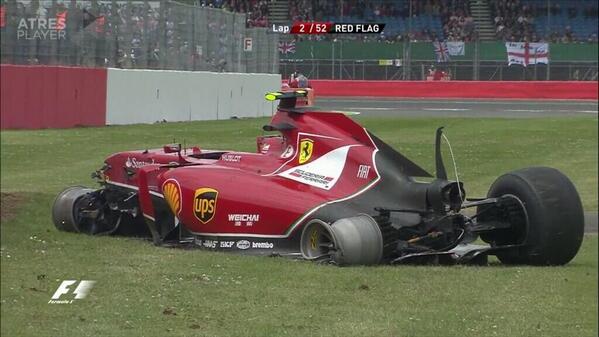
Catarham F1 team crash testing parts of their 2014 car Computer-aided design has assisted teams in identifying weak points and assessing the impact of high g-force crashes of the body of the car. It's not uncommon to see crashes in F1, but amazing to see that after a 150mph trip into a wall, drivers are able to get out of the vehicles without a single scratch. Of course there are other aspects which contribute to this such as absorbent crash barriers and safety helmets; a large contribution is the way in which the car can withstand such an impact stems from the clever design of the bodywork and chassis. This together with the development of very clever materials such as carbon fibre has resulted in cars that are lighter, stronger and ultimately faster than the next competitor. Road cars and in particular high end super car manufacturers have directly applied these technologies to make some of the fastest but also best looking cars on the planet.


 photo raik.png


Raikkonen crash Silverstone 2014: 150mph into a wall and walks away unharmed as a result of years of impact testing Image Credit

Aerodynamics

Another aspect of car design that can find its roots in F1 is undoubtedly aerodynamics. Allied to the advancement of very clever body shapes and construction of light and strong materials, F1 teams spend a larger proportion of their development time in the wind tunnel, assessing how the air flow helps grip levels around a track. Road cars have used some of this know-how to produce active aero and generally more "slippery" body shapes to make cars more stable at high speeds but also more fuel efficient.

Power

In addition to making cars safer and stickier to the tarmac around a race course, a huge amount of investment has of course gone into power and drivetrain development. Engines are now more fuel efficient through the use of smaller, turbocharged power units and gearboxes which have 8 forward speeds selected via steering wheel mounted paddles also feature on every car. In both cases this is technology which has directly influenced road car design. The traditional gearstick is being replaced with paddles even at the most affordable end of the sports car range, for example the new Renault Clio 200 no longer uses conventional transmission. Cars like the Nissan GTR and most of VAG's DSG equipped range were always designed with such a gearbox in mind, with added benefits meaning reduced shift time and better use of the engine's available power. Manufactures are also downsizing to 1.6 turbocharged engines in favour over 2.0L+ naturally aspirated engines.

Recent developments

 photo williamsfw36.png


2014 Williams FW36 car showing sophisticated rear wing set up 

Some of the most recent developments in F1 over the last few years put the spot light on electric power (re)generation. With this season's cars having up to 160bhp available through electric power alone, this marks one of the most significant advancements in car design. The system uses clever electric systems which are able to generate electric power through the use of kinetic and heat energy dissipated while braking and translates this into useable power at the wheels. This type of system is still very new and hasn't made it into mainstream cars yet but will definitely be evident in the next 5-10 years as manufacturers are pressured to save fuel and meet ever more demanding emissions targets.

Whatever the future holds for car design, it is certain that Formula 1 will be at the forefront of car technology development as the link between track and road performance grows ever stronger. It is already evident that the focus of F1 has changed over the last 20 years and will certainly continue to generate its future success through this unique mix of exciting racing and practical design application for many years to come.

Previous Article
The Five Best Driving Films
Next Article
What to look for when buying used rims

Get in touch

Questions about fitment, finance, or an order you have already placed? Our advisors know these wheels inside out and are happy to help.

Contact us


Contact us Contact us

Frequently Asked Questions

View all
What should I do if my order is delayed?

Most delays are temporary. Follow these steps:

  1. Check your tracking link in the Shipping Confirmation email.
  2. Wait 24–48 hours after the estimated date — carriers sometimes update late.
  3. If no update in 3 business days, contact us with your Order Number and Tracking Number.
  4. We’ll investigate and either reship free or issue a full refund if lost. Note: During sales or holidays, add 1–2 extra days.
Can I change my delivery address after placing the order?
Unfortunately, we are unable to amend delivery addresses once an order has been placed. For security purposes, items can only be dispatched to the billing address associated with the payment method. We kindly ask that you carefully review your shipping and billing details at the checkout screen before confirming your purchase
What will happen if I miss the courier?

The delivery driver will leave a card saying that he has made a delivery attempt, along with instructions on what to do next.

What should I do if my delivery is overdue?

We do ask you to allow up to three working days for courier deliveries. If your goods still have not appeared after that time or no one has contacted you by email or telephone, please email us at [email protected].

How do I track my order?

After placing an order online, you will receive a confirmation email. Following this your order will be set to processing and then delivered once it has been dispatched. After you receive the delivered notification via email, you will receive an email or text message from the courier with your tracking number. 

I have not received an invoice - what should I do?

Although we carry a large range of wheels and tyres in stock, we cannot have everything, so in some cases if a product is being sent directly from the manufacturer an invoice will not be included in the parcel. You should receive an invoice by mail a few days later. If you do not receive an invoice, please email [email protected] so we can arrange a copy.

What happens if my goods arrive damaged?

Very occasionally goods get damaged in transit. We always inspect the products before we pack them but after they leave our hands accidents do happen. Please sign the delivery docket with the driver 'damaged' if the outer packaging looks damaged in any way. We then ask you to inspect goods upon receipt and notify us of any damage within 24 working hours by calling us on 01274 877787 or sending us an email at [email protected]. 

If the goods have been damaged in transit and are faulty, we reserve the right to replace the product. We will of course arrange a collection for the damaged parts and arrange replacements as soon as possible. Please keep all packaging and do not try to fit the damaged parts.

I’ve received the wrong part - what should I do?

If something is not right about the goods that you have received, please email us at [email protected] or telephone us to let us know. All goods are sold to the manufacturer's Conditions of Sale and Guarantee. Goods specially ordered cannot be returned for credit. We reserve the right to make a handling charge on goods returned against orders correctly executed.

What are the advantages of alloy wheel upgrades?

Aftermarket alloys are typically lighter than their stock counterparts, reducing unsprung weight and improving the performance of your car. They’re also available in larger diameters and widths, allowing larger brakes and wider tyres to be installed for increased cornering performance and stopping power.

What is the lifespan of alloy wheels?

Alloy wheels have a far longer lifespan than steel wheels. When well cared for, they can last for decades - and they can be easily refurbished and restored to look as good as new.